Residential real estate
Quebec Land Register: What Is It For, and What to Ask Before You Buy
· 7 min read
Vanessa and Louis are about to make an offer on a house. Their notary sends them the list of documents he plans to look at: an earlier deed of sale, a hypothec and a servitude. Vanessa is worried, because she does not know what a servitude is. Louis wants to understand everything before signing. Both have just run into the land register, the large body of documents people mention constantly when buying property and rarely explain.
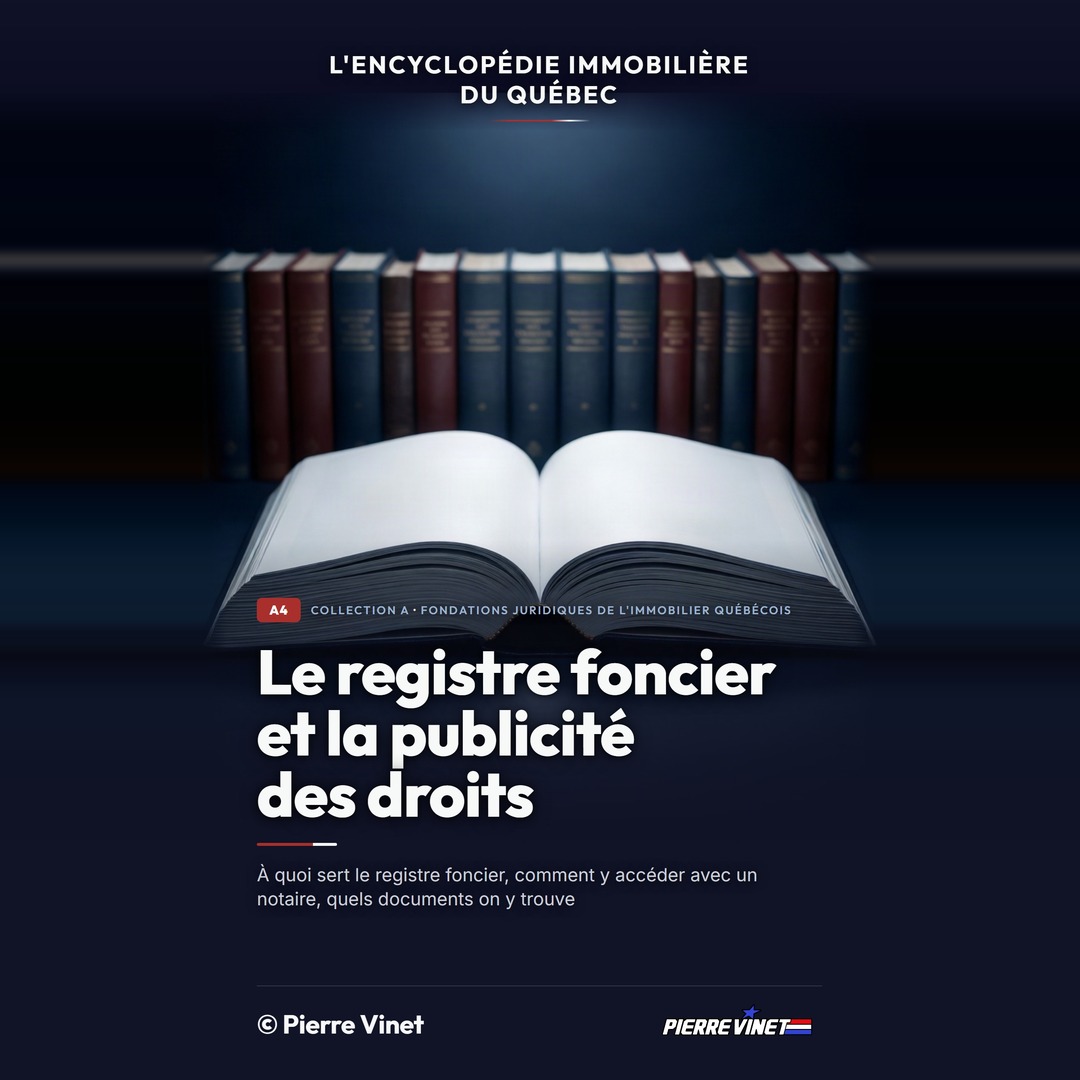
These two people are fictional, like every case in the book Le registre foncier et la publicité des droits (The Land Register and the Publication of Rights), free to read on pierrevinet.com. The book is in French. Their situation, however, is a very ordinary one.
What is the land register?
The Québec land register is a public register. It gathers, property by property, the documents that concern that property. The book gives a simple picture: it is the big library of a property's papers.
Each time ownership changes hands, a loan is granted or a neighbour is given a right of way, a document is signed. Without a common place to find them, it would be nearly impossible to know, when you buy, what has already happened on the property.
What does "public" mean here? Not that anyone can find everything, instantly and with no steps. The conditions of access are checked on the website of the Registre foncier du Québec and with your notary. The word mostly tells you that these documents are not sitting in a private drawer: professionals consult them to do their work.
How the register works falls under the Civil Code of Québec. The book simply names it and does not say what its rules allow or require in your case. That question goes to your notary or a lawyer.
Which documents can you find in it?
The book sorts documents into three families, each answering one question:
- Where does the property come from? The deed of sale, earlier deeds, sometimes deeds of gift or partition.
- How was it financed? The deed of hypothec, which is the security given to a lender in exchange for a loan, and related documents.
- What affects the use of the land? Servitudes, for example a right of way granted to a neighbour, their plans and various notices.
This sorting is not legal. It is a reading tool. A word like "hypothec" or "servitude" calls for questions, not conclusions: a servitude is neither good nor bad in itself, it is an item in the file that you should know about before signing. Faced with the word "servitude," Vanessa and Louis wrote: where is it? what does it allow? is our shed project something to discuss with you before the final offer?
Why the lot number matters as much as the address
The register files its documents by lot number, not by street address. A lot is a parcel of land that has been given a number, like a label stuck on the land. An address can change; the lot number identifies the land without depending on the street name.
Picture two neighbouring houses whose addresses differ by one digit. If you absent-mindedly write down your neighbour's number, you will be handed the documents of the wrong property.
Three simple habits:
- always give the address and the lot number when you make a request;
- have your notary or land surveyor confirm the number in writing, since a number found alone on an old paper needs confirming;
- do not confuse the lot number with a roll or account number, which does not replace it.
Who can help you consult the register?
The book separates the roles:
- The notary consults the register to learn the property's history. You ask which documents he looked at, what he takes from them, and to explain it in plain words.
- The land surveyor (arpenteur-géomètre) deals with boundaries and plans. To know exactly where a boundary runs, he is the one to call, not the notary.
- The broker, if you have one, passes your questions to the seller and confirms the answers in writing. He does not interpret a land register document.
The Registre foncier du Québec service is the official front door. Searching online helps you prepare your questions, not answer them. The book suggests stopping before you pay or order anything, so you can read the fees and discuss them with the notary. An empty result does not prove that no document exists: ask the notary to run the search again.
What should you ask before buying?
Your questions count most before the signature. Here is the core of what the book suggests asking the notary:
- Which deeds did you look at, and how far back do they go?
- Is the seller really the person named in those documents?
- Is there a hypothec on file, and what is planned for it at the sale?
- Is there a servitude or other document about the use of the land, and where is it?
- What is the lot number, and can you confirm it in writing?
- Is the certificate of location recent enough for this transaction?
- Which documents should I read carefully before signing?
Through the broker, you can ask the seller whether he has his purchase deed and a certificate of location, whether he received letters or notices about the property, whether he knows of a right of way, and whether the property is tied to a loan. "I don't know" is a valid answer: write it down as is. A seller's answer is not a verification, though; it is checked against the documents.
Land register documents do not tell the whole story: the condition of the building, the rules on how the land may be used, or the environment are checked elsewhere.
How do you protect your personal information?
A document meant for a public register may contain information about you and be consulted by others. You cannot count on its being kept secret. The question to ask your notary before signing: "What will this document say about me, and who will be able to consult it?"
The book also teaches you to recognize the signs that should stop you: contact you did not ask for, from someone claiming to know your property; pressure to answer or sign quickly; a request for money or personal information to "protect" your property; an instruction to tell no one, your notary included. Knowing your address or your lot number proves nothing. If in doubt, do not respond, and call your notary back using contact details you already have.
What is in the land register toolkit?
The last chapter gathers everything in one place:
- a checklist of documents to request, following the three families, the documents that identify the land and those you produce yourself;
- standard questions for the notary, the land surveyor, the broker, the lender and the lawyer;
- a tracking table: document, what it is for, requested on, received on, to clarify.
What does this land register guide not tell you?
This book never tells you what the law provides for your property or what a registration is worth in a dispute. It shows where the documents are, who can help you read them and which questions to ask. It replaces neither the notary, nor the land surveyor, nor the lawyer. It helps you consult them better.
📘 Read the book for free (in French): Le registre foncier et la publicité des droits.
🏡 Thinking of buying or selling? I will guide you at every step, from assessing your needs to coordinating the transaction. Book a meeting with no obligation.
Pierre Vinet, residential and commercial real estate broker · Immobilier Pierre Vinet Inc. · eXp Agence Immobilière · holder of a real estate broker's licence issued by the OACIQ
Frequently asked questions
Who explains the land register documents for my property? The notary. Ask which documents he consults, a copy of each, and a summary in plain words.
Why am I asked for the lot number and not just the address? Because the register files its documents by lot number. Give both, and have the number confirmed in writing.
Who do I consult to find where my property line runs? The land surveyor. The words of a deed do not replace a measurement on the ground.
Is the book free? Yes. Le registre foncier et la publicité des droits is free to read on pierrevinet.com, in French.
General information only. This text is not legal, tax or financial advice and creates no professional relationship. Consult a notary, a lawyer, a land surveyor or another qualified professional about your situation.