Residential real estate
Owning Property in Québec: What “Owning” Really Means, and Who to Consult
· 6 min read
A seller tells a buyer: "The shed at the back is included in the sale." The buyer nods. Nobody checks where the shed sits in relation to the property line, or what the documents say. A few months later, a surprise appears.
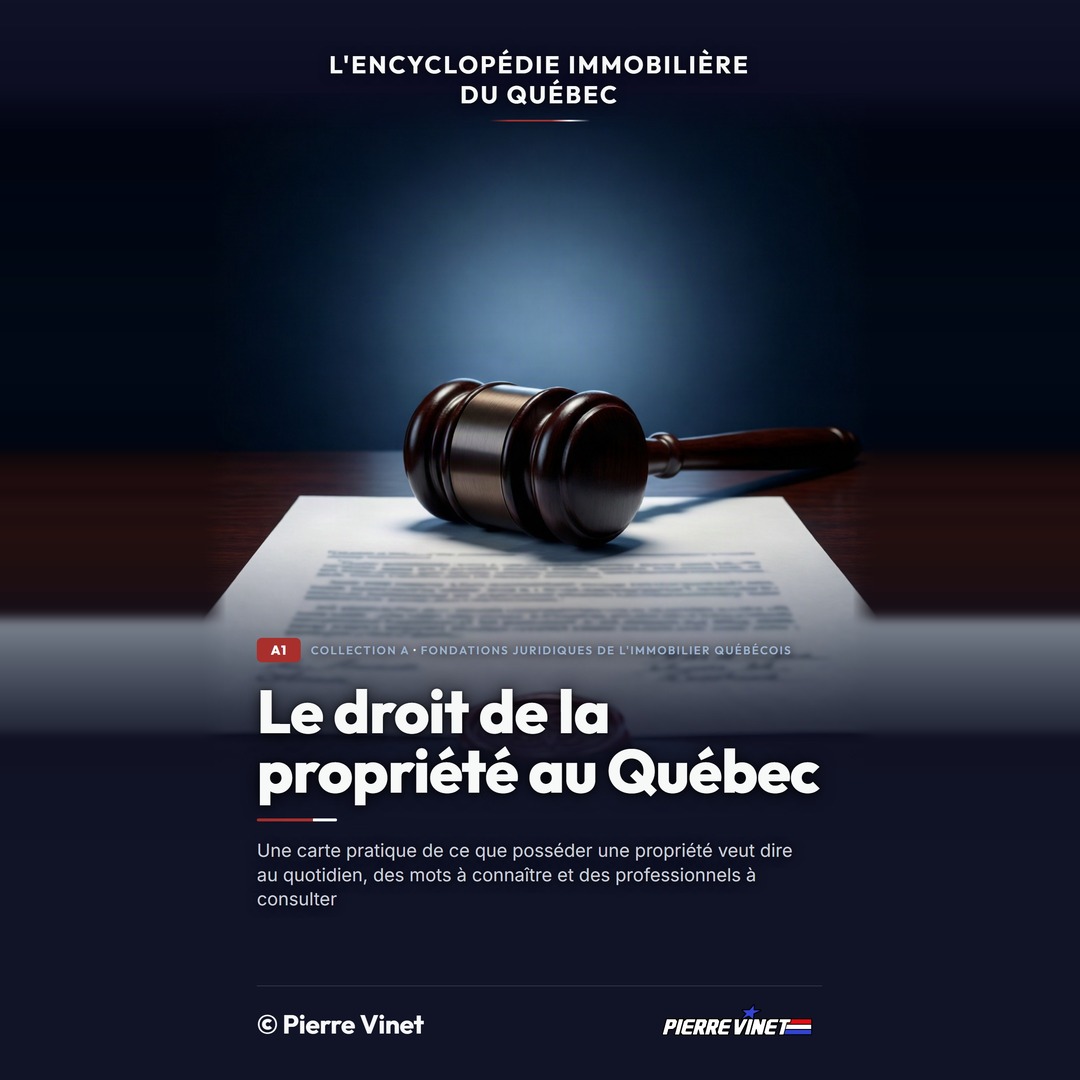
None of this was inevitable. One question, asked in time to the right professional, would have been enough. That is the whole spirit of Le droit de la propriété au Québec (Property Law in Québec), the first book of L'Encyclopédie Immobilière du Québec, free to read on pierrevinet.com (French edition).
A simple word, several realities
In everyday life, being an owner seems simple: the house is ours. In reality, ownership takes several forms. You can own:
- a house and its land;
- a unit in a building shared with others;
- jointly, with two, three or more people;
- land crossed by a neighbour's path, or with a wall shared with the house next door.
Each situation comes with its own words, documents and questions. The words look alike without meaning the same thing: land, lot, immovable, building, title, fraction, servitude. Mix them up and you ask the wrong questions, or forget to ask the right ones.
Four professionals, four roles
The book stresses one point: tell a practical question, which you can handle yourself, from a legal question, which goes to a professional. And know who to ask:
- The notary reads and executes deeds, and explains the documents that establish what you own.
- The land surveyor measures and describes the boundaries of the land.
- The lawyer advises and represents you when a legal question goes beyond reading the title, or when a dispute arises.
- The real estate broker guides the buying or selling process.
An owner's journey, from above
The book draws the full map, from first visit to resale:
- Before buying: understand what you are buying. What is sold with the house? Where are the boundaries?
- At purchase: read before you sign.
- After buying: live in the property, maintain it, renovate it, rent part of it.
- Owning with others: divided co-ownership, undivided ownership, neighbours.
- When doubt sets in: know what to do and who to consult.
- When you sell: prepare your file.
At every step, the book gives the words to know, the documents to request and the questions to ask.
What is included in the sale of a house?
It is one of the most common questions during a visit, and the answer does not come from an impression: it comes from the documents and the written agreement. The book offers a simple tool, the visit inventory:
- Prepare a notebook or a document, with one section per room and one for the outside.
- With the seller's permission, photograph every item that raises a question.
- Write down what you see, in plain words: built-in dishwasher, pendant light fixture, curtains and rod.
- Highlight what makes you hesitate: a new appliance, an added feature, an item you are not sure will stay.
- Note what the seller says, with the date, and ask your broker to have it confirmed in writing.
- Give your inventory to your broker and your notary, who will see how the important items are written into the promise to purchase and the deed.
"The hot tub stays" or "the light fixtures stay": said during a visit, these sentences leave no trace. A spoken word is not a document.
Five checks before a major project
Expanding, renovating, renting part of the house or selling: before you start, the book recommends five checks.
- Your documents: title, certificate of location, plans, insurance policy. Note what concerns your project and ask your notary your questions.
- The municipality: ask whether your project requires a permit, and keep the answer in writing.
- Your neighbours: if the project may affect them, talk to them before you start.
- Your insurer and your lender: tell them about any project that changes the property.
- Your professionals: notary, land surveyor, lawyer, contractor or broker, depending on the project.
A project started without checking may have to be changed, stopped or undone. Going back usually costs far more than a question asked in time.
The homeowner's file
An owner who keeps an orderly file saves a lot of searching, and makes resale easier. It holds the title and the documents handed over at the notary's office, the certificate of location and the plans, the insurance policies, the invoices and warranties for work and appliances, municipal permits, correspondence, dated photos and your meeting notes. All in one place, on paper or digital, with a backup copy.
A toolkit to keep at hand
The last chapter brings everything together in one place:
- a checklist before a purchase, before renovations and before a sale;
- standard questions for the notary, the land surveyor, the lawyer, the broker, the municipality, the insurer and the lender;
- a tracking table to keep your questions, answers and documents in writing.
On the day you need it, during an offer to purchase, a renovation project or a disagreement with a neighbour, you will not have time to reread a whole book. The toolkit will be ready.
A map, not advice
The book never says what the law allows, forbids or requires in your case. It helps you know what to do, in what order, with which documents and who to consult. It replaces neither the notary, the land surveyor, the lawyer nor the broker. It helps you work with them better.
📘 Read the book free: Le droit de la propriété au Québec (in French).
🏡 Thinking of buying or selling? I guide you through every step, from assessing your needs to coordinating the transaction. Book a 30-minute meeting, with no commitment.
Pierre Vinet, residential and commercial real estate broker · Immobilier Pierre Vinet Inc. · eXp Agence Immobilière · holder of a real estate broker's licence issued by the OACIQ
Frequently asked questions
Who can tell me the exact boundaries of my land? A land surveyor. This is the professional who measures and describes the boundaries of a property.
Who explains what I actually own when I buy a property? The notary. The notary reads the documents that establish what you own and explains their terms.
Is everything on the land included in the sale? Not necessarily. What is included depends on the documents and the written agreement, not on an impression during the visit. Ask your broker and your notary, and have it put in writing.
Is the book free? Yes. Le droit de la propriété au Québec is free to read on pierrevinet.com, in French.
General information only. This article is not legal, tax or financial advice and creates no professional relationship. Consult a notary, a lawyer, a land surveyor or another qualified professional about your situation.