Residential real estate
Before You Sign a Real Estate Contract in Québec: What to Read, Ask and Whom to Consult
· 8 min read
Amélie and Karim are buying their first home. The evening before a meeting, their broker emails them a document to sign and several attachments. It is late. Rather than skim it all, they decide to read it separately, then compare notes over breakfast. They arrive at the meeting with six or seven points to clear up, and they ask their questions before signing.
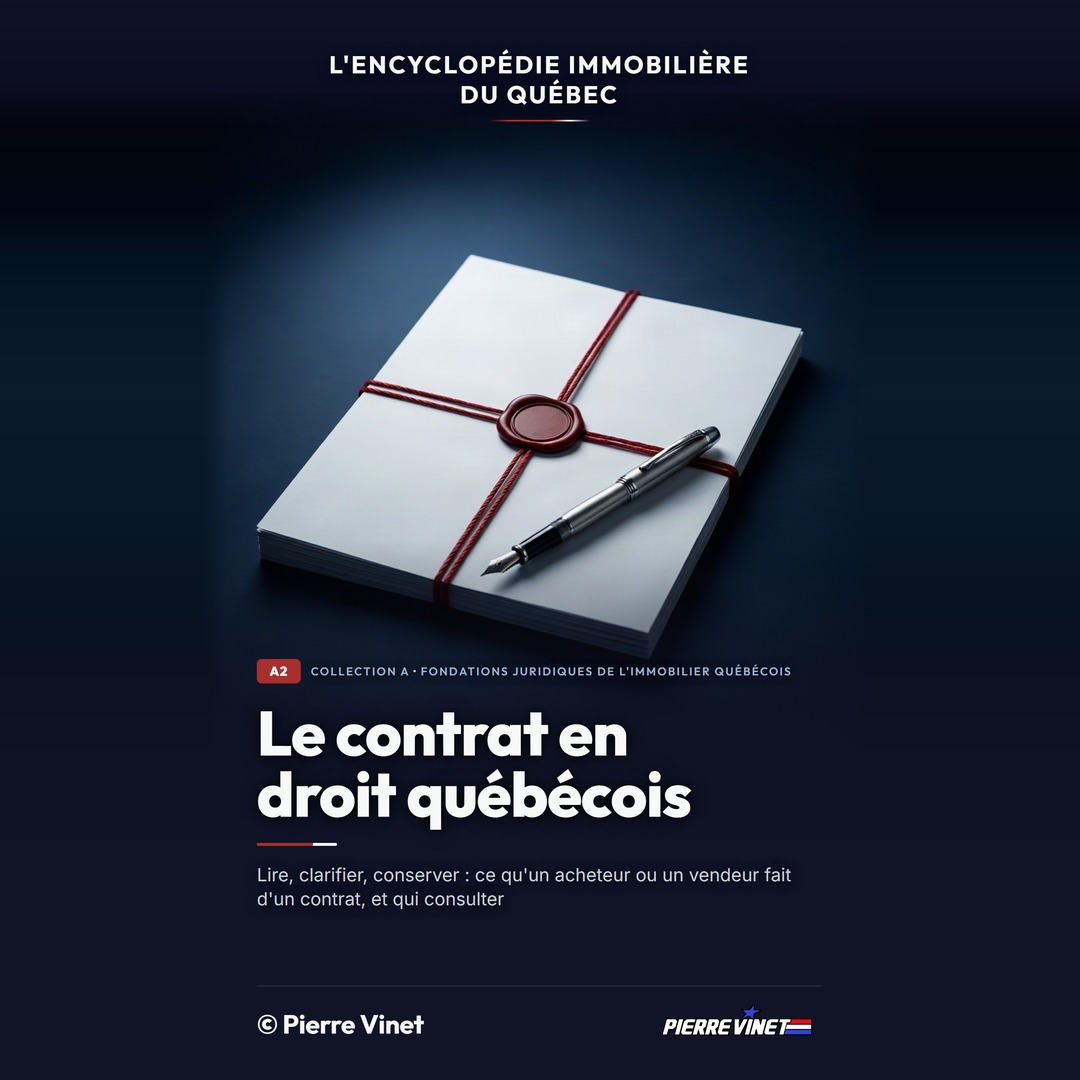
Amélie and Karim are fictional characters, but their habit applies to any real estate contract. That is the spirit of Le contrat en droit québécois (The Contract in Québec Law), the second book of L'Encyclopédie Immobilière du Québec, free to read on pierrevinet.com (French edition).
Why does a real estate transaction involve so many documents?
When two people agree on the sale of a house, they agree on many things at once: the property, the price, the date the keys change hands, what stays in the house, what must be checked. Nobody can hold all that in their head. The written document fixes what was agreed, so both sides are talking about the same thing.
Depending on whether you buy or sell, you will meet several documents:
- a document engaging a broker to represent you, if you choose one;
- an offer or promise to purchase, with its schedules;
- replies, amendments or notices along the way;
- financing documents, if a lender is involved;
- the deed of sale, signed at the notary's office.
A written document says only what is written in it. What you think you agreed in conversation may not be there. That is why reading before signing matters.
How do you read a contract before signing it?
The book does not ask you to become a lawyer. It offers five habits, the same from one document to the next: ask, read, note, question, keep.
- Ask for the complete document, schedules included, before the meeting. Keep a record of your request: an email is enough.
- Read in two passes. First in one go, to see how the document is built. Then slowly, pencil in hand.
- Mark three things: what you understand, what you do not understand, and what differs from what you were told.
- Turn your marks into short questions, with the page number.
- Sort your questions by the person who should answer them.
If the document is slow to arrive, the book suggests asking again politely, offering to postpone the signing and asking what the rush is. If the pressure continues, talk to a notary or a lawyer before going further. You can also simply say: "I would like to read the document before signing."
What should you look for in a contract? The six blocks
During the careful reading, the book suggests looking for six answers:
- Who? The parties and their capacity.
- What? The property described, what is included or excluded.
- How much? The price and every other amount, written the same way wherever they appear.
- When? Every date, including moments expressed other than as a date.
- On what conditions? What must be checked or carried out.
- With which schedules? The attachments mentioned in the text.
If one of the first three answers is missing or differs from what you were told, that is your first question. The book also invites you to mark the passages that limit (words like except, only if or does not include) and to read them twice. You are not judging whether the document is good, only checking that it matches what you know.
Whom should you consult: the broker, the notary or the lawyer?
Asking the right question of the right person helps you avoid leaving with an uncertain answer. The book separates three kinds of questions:
- Process: what happens next? which document is missing? who has to sign? Ask your broker first.
- Fact: what was said, written or handed over, and on what date? Your documents and notes answer these.
- Meaning and scope: what does this passage mean for me? what does this change do? These go to the notary or the lawyer, with the document in hand.
The book adds the lender for the figures and deadlines of your financing. The lawyer is the person you consult for a disagreement, a letter mentioning legal remedies or an unusual situation. If you cannot tell which of the three to call, start with the broker or the notary: they will tell you whether to go further.
What should you do with promises, conditions and dates?
A transaction document is largely an exchange of written promises, with conditions and dates attached. The book teaches you to reread them as commitments to remember:
- a two-column table, what I promise and what the other party promises, with the page of each;
- for each condition, four notes: what must be checked, who is responsible, by when, and how it is reported;
- a calendar of your own, where you enter every date with the page of the document and a reminder.
A moment expressed other than as a date, for example a number of days after signing, is not something to work out alone. Ask the broker for the exact date, then the notary if in doubt, and have it confirmed in writing. If a condition may not be met in time, tell your broker right away: avoid both waiting for it to sort itself out and acting alone.
How do you keep your contracts and find them again?
Odile, another fictional character in the book, is looking for the contract from her purchase, made long ago. Her papers are in a box and two drawers, in no order. The book proposes the opposite:
- one file per property, paper and digital, with sub-folders (purchase, property, insurance and accounts, sale);
- the signed text, schedules, amendments, important messages and receipts, kept together;
- a copy in another place (elsewhere in the house or with a relative), and a digital backup;
- a fixed appointment with your papers, for example once a year.
Do not throw away a real estate contract, even a scanned one, before asking the notary. And to find an old contract, look first at home and in your emails, then ask in writing for a copy from the notary or the broker who handled the transaction.
Which tools help you track your real estate contracts?
The last chapter brings everything together in one place:
- a checklist before signing, where every empty box becomes a question to ask;
- standard questions for the broker, the notary, the lawyer and the lender;
- seven tracking tables: reading, attachments, commitments, calendar, versions, list of your contracts and timeline of facts.
For a small file, a notebook is enough. What matters is having one place, and using it.
Can a contract guide replace a professional?
The book does not say what a contract means in law, or what happens if a party does not keep a promise. It names the Civil Code of Québec so you know it exists, and leaves it to the notary or the lawyer to tell you what it implies for you. Its role is to help you know what to do, in what order, with which documents and whom to consult. It replaces neither the broker, the notary nor the lawyer: it helps you work with them better. The characters and cases in the book are fictional.
📘 Read the book free: Le contrat en droit québécois (in French).
🏡 Thinking of buying or selling? I guide you through every step, from assessing your needs to coordinating the transaction. Book a 30-minute meeting, with no commitment.
Pierre Vinet, residential and commercial real estate broker · Immobilier Pierre Vinet Inc. · eXp Agence Immobilière · holder of a real estate broker's licence issued by the OACIQ
Frequently asked questions
Can you ask for a contract before signing it? Yes. The book recommends asking for the complete document, schedules included, before the meeting, and keeping a record of the request by email.
Whom do you ask about the meaning of a passage? The notary or the lawyer, with the document in hand. The broker can place the passage within the transaction, but does not replace their advice.
What if I am pressed to sign? Stay calm and say, for example: "I will give you my answer after reading." Ask what the rush is and where the deadline is written. If the pressure continues, talk to a notary or a lawyer.
Is the book free? Yes. Le contrat en droit québécois is free to read on pierrevinet.com, in French.
General information only. This article is not legal, tax or financial advice and creates no professional relationship. Consult a notary, a lawyer or another qualified professional about your situation.