Residential real estate
Buying, Owning or Selling a Home as a Couple: What to Ask, and Who to Ask
· 8 min read
The offer has been accepted. The broker warns Justine and Marc-André, the fictional couple followed in the book, that the notary will ask: "In whose name will you buy?" They have never talked about it in any detail.
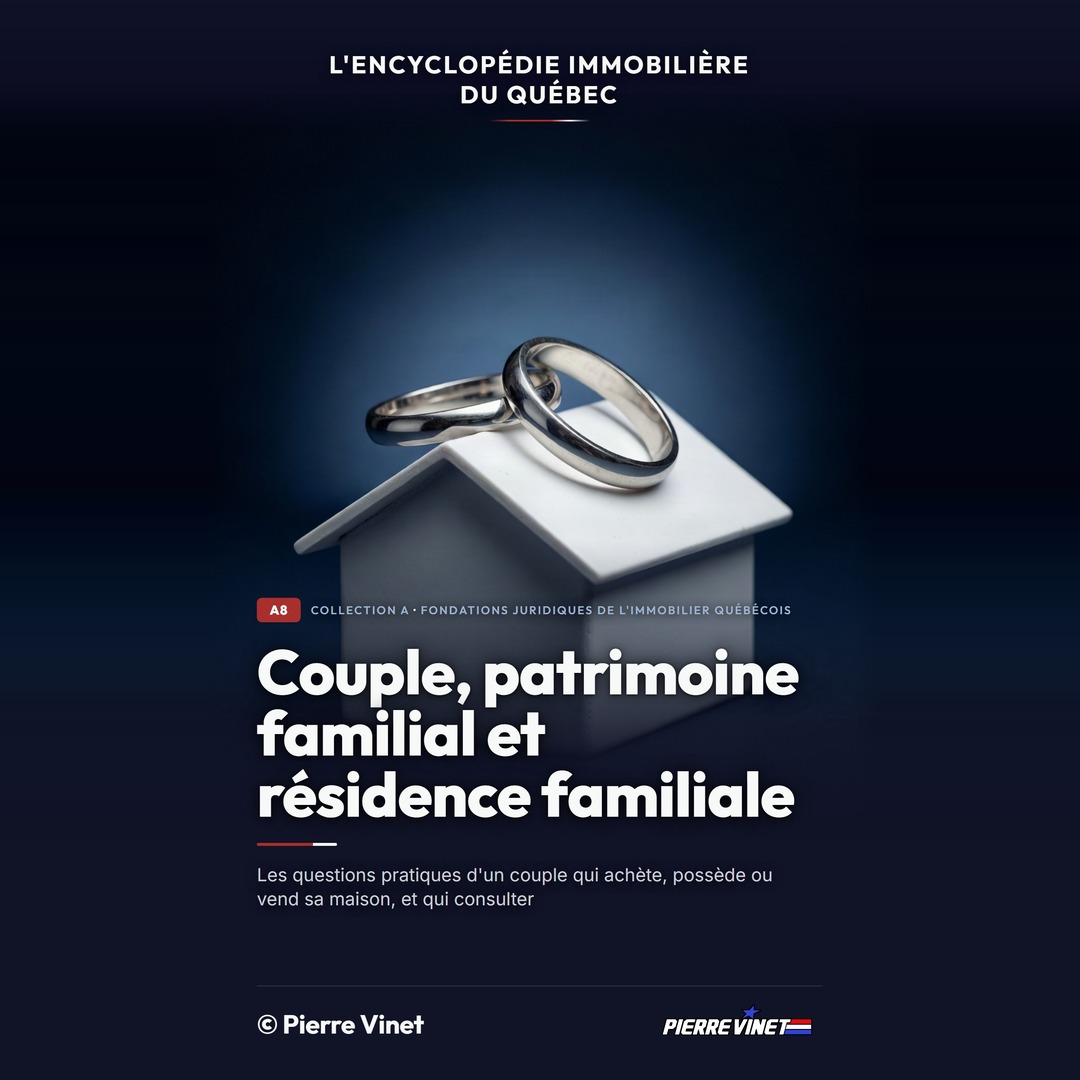
Buying a house as a couple means making together decisions you would make alone if you lived alone. Couple, patrimoine familial et résidence familiale (Couple, Family Patrimony and Family Residence), a book in L'Encyclopédie Immobilière du Québec, is free to read on pierrevinet.com, in French. It does not hand you the answers. It helps you prepare your questions, your documents and the conversation between the two of you.
What does this book do, and what does it not do?
It does five things:
- it helps you prepare conversations, first between the two of you and then with professionals;
- it offers checklists of documents to gather and practical steps to take;
- it gives standard questions for the notary, the lawyer, the accountant, the financial planner and the lender;
- it helps you keep a written record of your decisions;
- it points you to the other books in the collection and to public sources.
What it does not do matters just as much. It does not say who is entitled to what. It does not interpret any legislation: the Civil Code of Québec is named, never described. It calculates nothing and replaces no professional. The three cases in the book are fictional, and it contains no calculations.
Family patrimony, family residence: what does the book say?
You will hear these two expressions when reading or talking with relatives. They are legal expressions. The book does not define them and does not say what they cover or who they apply to. It invites you to write them down and ask a notary or a lawyer.
The reason is simple. A general-audience book speaks to thousands of readers whose situations differ. A professional checks your facts, your documents and the current legislation before answering you.
Married, in a civil union or common-law: why are you asked to state your situation?
Those are the three everyday expressions for describing a couple's situation. In front of a notary, a lawyer or a lender, you will be asked to state yours: those questions serve to fill in the documents correctly and to check that nothing is overlooked. The book does not compare these situations and does not say what each one means for your home.
Two traps to avoid:
- using one word for another, out of habit or to keep things simple;
- assuming your partner sees the situation the way you do.
Before any appointment, set aside twenty minutes with no screens. Ask yourselves which word each of you uses, which documents you have already signed, what one of you takes for granted that the other has never checked, and which subject you avoid. Write the answers in two columns. Where they differ, you have found a question for the professional.
In whose name should a couple buy a house?
The book does not choose for you and does not describe the consequences of each choice. It stresses one point: this is a decision, not a detail, and it is prepared before meeting the notary. Here is the method it suggests:
- each of you writes down, separately, what you think about how to buy, and why;
- each reads their page aloud to the other, without interruption;
- together, you note what is the same and what differs;
- you draw up the list of questions for the notary;
- you do not try to settle it that evening.
The most useful column of the preparation sheet is titled "What I don't know". It stops you from presenting an assumption as a fact. And if you disagree, write it down as it is: a disagreement is not a failure, it is information to bring to the notary.
Should you talk about money before buying together?
Yes, according to the book, and early. A disagreement often comes from expectations that were never spoken, more than from a lack of money. Start with your goals, then go through seven categories:
- the purchase itself;
- the loan;
- taxes and insurance;
- regular upkeep;
- renovations;
- everyday expenses;
- savings.
For each one, ask two questions: how does each of us see this? What do we not yet know? The book suggests a three-column budget: what comes in, what goes out each month, what goes out once a year. Write "to verify" rather than guessing.
A budget is not an agreement. If the idea of a written agreement crosses your mind, that is a question for a notary or a lawyer, who will know what form it could take.
Which documents should a homeowner couple keep?
The book separates the documents about the house (purchase, loan, insurance, tax bills, inspection report, certificate of location, plans, renovation invoices) from those about the couple (identity papers, contracts already signed, financial documents). It suggests sorting them into three folders: one for each of you, and one for the two of you.
Its basic rule fits in a sentence: both of you know where the documents are. Hence a few concrete habits:
- keep a one-page list showing where each original and each copy is;
- store copies somewhere other than the originals;
- go through your documents once a year;
- note what is missing; if a document is lost, do not recreate it yourselves, and inform the notary, the lender or the body that issued it.
Notary, lawyer, accountant or financial planner: who should you consult?
The book answers with a simple division:
- the notary: how to buy, the documents to sign and keep, who must sign and be present;
- the lawyer: a legal question that goes beyond the meeting with the notary, or a process in which your interests might differ;
- the accountant: tax questions;
- the financial planner: budget, goals, debts and savings;
- the lender: its conditions, documents, fees and timelines, to be confirmed directly with it.
When life changes, should you review your documents?
The papers signed on purchase day describe the life you had that day. A birth, an inheritance, a job change, a retirement, an illness, a separation or a death are all moments to ask whether your documents reflect what has happened. The book does not say what to change. It says when to talk to a professional.
For each event, it offers five questions: what has changed? Who is affected? Which documents or steps could this touch? Who should we talk to? When? Fernand and Lise, another fictional couple in the book, ask themselves these since Fernand retired: they list their documents, note what has changed, then talk to a notary.
What checklist should a couple buying together use?
The last chapter brings everything together: a checklist for each of the five stages of the journey (before buying, at purchase, while owning, before a major change, when life changes), standard questions for each professional, and a tracking table where you record the question, the person consulted, the answer and what remains to be done. On the day you need it, you will not have time to reread the whole book. The toolkit will be ready.
📘 Read the book free: Couple, patrimoine familial et résidence familiale (in French).
🏡 Thinking of buying or selling together? I guide you through every step, from assessing your needs to coordinating the transaction. Book a 30-minute meeting, with no commitment.
Pierre Vinet, residential and commercial real estate broker · Immobilier Pierre Vinet Inc. · eXp Agence Immobilière · holder of a real estate broker's licence issued by the OACIQ
Frequently asked questions
In whose name should we buy our home? The book does not decide: it is a question to prepare together, then put to the notary, who knows your situation and your documents.
What do "family patrimony" and "family residence" mean? They are legal expressions that the book names without describing. Write them down and ask a notary or a lawyer what they mean in your case.
Should we consult a notary or a lawyer? The notary is a good starting point for how to buy and for the documents. A lawyer fits when a legal question goes beyond that meeting. The book helps you choose.
Is the book free? Yes. Couple, patrimoine familial et résidence familiale is free to read on pierrevinet.com, in French.
General information only. This article is not legal, tax or financial advice and creates no professional relationship. Consult a notary, a lawyer, an accountant or another qualified professional about your situation.